Forestry mulching is how we clear cedar and brush on lived-on acreage without tearing up the ground. We run a tracked Cat 275 with a Mastodon forestry head that grinds trees and undergrowth into mulch right where they stand. No burn pile. No dump trucks. No open holes left behind.
We work best on the kind of place people actually live on: a few acres outside Edmond, Yukon, Guthrie, Piedmont, Okarche, Kingfisher, El Reno, and the rest of the west and north metro. If your lot is thick with eastern red cedar, plum thickets, sumac, or scrub that has taken over the yard and fence line, that is our job.
What we clear (and what we leave)
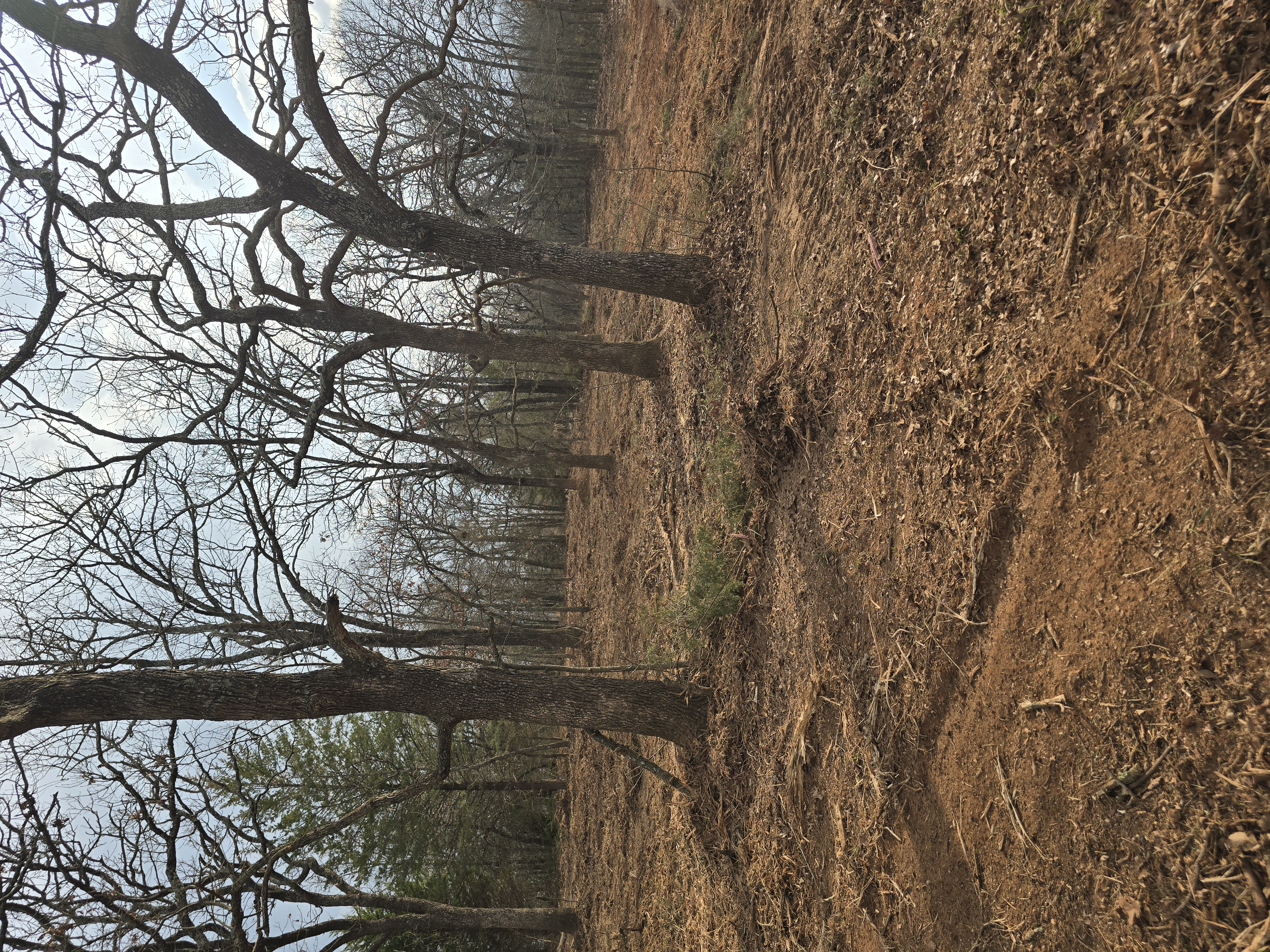
We mulch trees up to about 12 inches. Bigger trunks get cut with a turbo saw and left or stacked on site unless we scope something different. You tell us what stays. Oaks you want to keep stay. A privacy strip along the road stays if you ask for it. The goal is land you can walk, mow, graze, or build on, not a bare dirt pad.
Everything we cut stays on the property as a mulch layer. That layer settles. Grass comes back through it. You are not left with a stump forest or a burn scar.
Mulching vs burning vs a dozer
Burning needs dry weather, a safe window, and someone watching the pile. A lot of towns and counties make that harder every year. A dozer pushes everything into a pile or scrapes the topsoil. That can work for a building pad. It is usually the wrong tool for a pasture or a yard you still want to use. See the full side-by-side on our land clearing page.
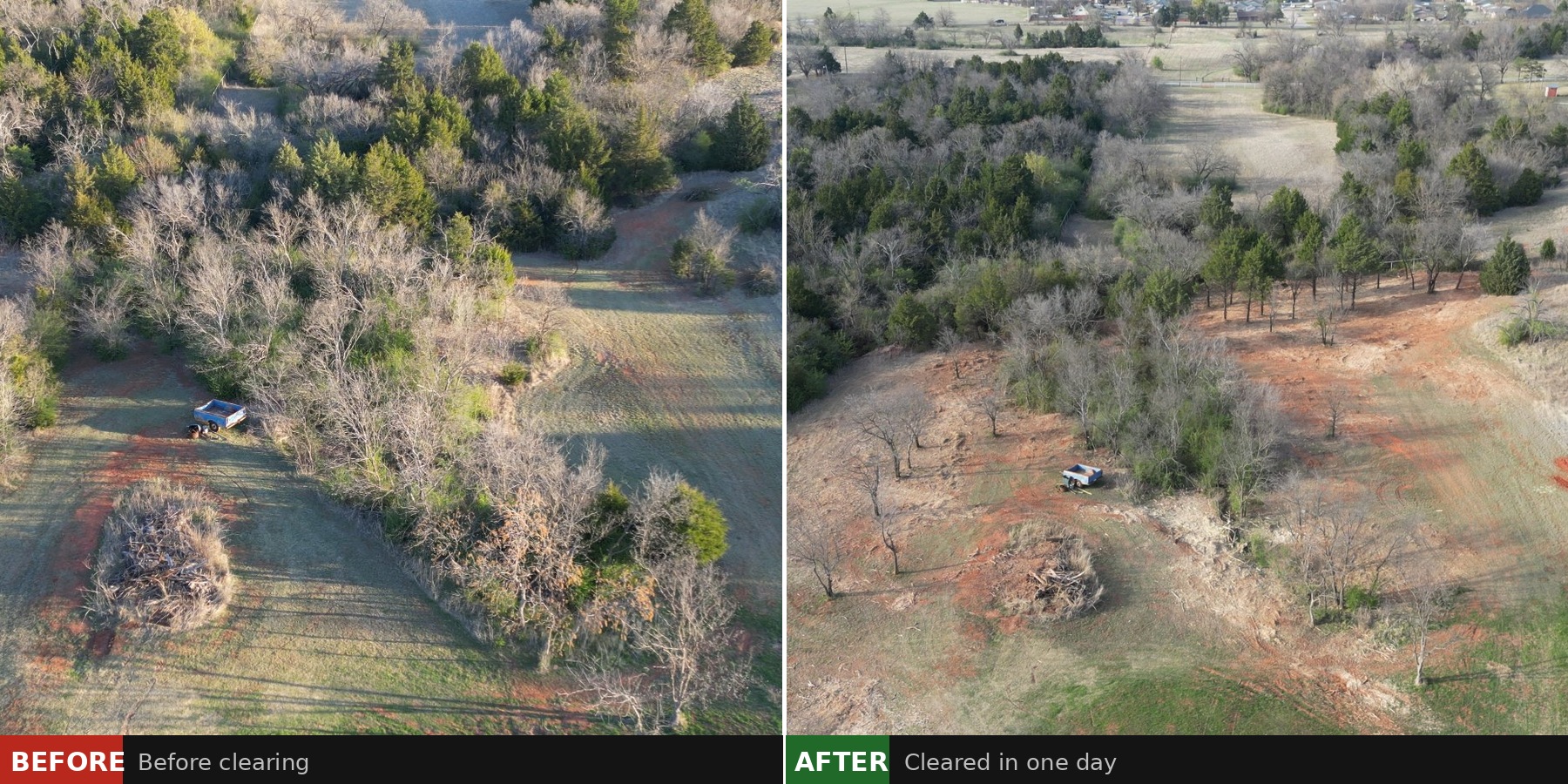
Mulching turns the problem into ground cover in one pass. When we leave, you can see the shape of the place again.
What the land looks like after
Customers describe the same thing: they can see through the property again. Fence lines show. Trails open. Pasture edges are walkable. A homesite that was a wall of cedar becomes a yard with room to park a trailer or set a shop. The mulch is brown and even. It is not landscaped like a golf course. It is usable Oklahoma ground.
Central Oklahoma acreage pricing
We price every job as one flat total after we walk it. Density, tree size, rocks, access, and soft ground all change the number. A blind per-acre guess either scares you off or burns us, so we do not do that. Walk the place with us. You get one firm price that covers the work we scope. Want a rough ballpark first? Try the instant pricing calculator, then book the walk for the firm number.
If cedar cost-share through OCC or EQIP is on your radar, apply before we start. We can talk about that on site. We never promise you will qualify.
Service area
Oklahoma Mulch Works is based in Oklahoma City and works Logan, Kingfisher, Canadian, Oklahoma, Cleveland, McClain, Lincoln, Grady, Blaine, and nearby counties inside a practical drive. See the full service area map. Lawton corridor jobs are possible when the size makes sense.
Common Questions
What size trees can you mulch?
We mulch trees up to about 12 inches in diameter. Bigger trunks get cut with a turbo saw and left or stacked on site unless we scope something different.
Do you haul anything off?
No. Everything we cut stays on the property as a mulch layer. That layer settles, protects the soil, and grass comes back through it. No burn pile, no dump trucks.
How does pricing work?
We price every job as one flat total after we walk it. Density, tree size, rocks, access, and soft ground all change the number, so we do not guess per acre over the phone. You get one firm price that covers the scoped work.
Ready to see your place opened up?
Call Josh at (405) 870-1381 or request a walk. Tell us the town, about how many acres, and what you want the land to be when we leave. We will get on the calendar and walk it with you.
Request a Walk →