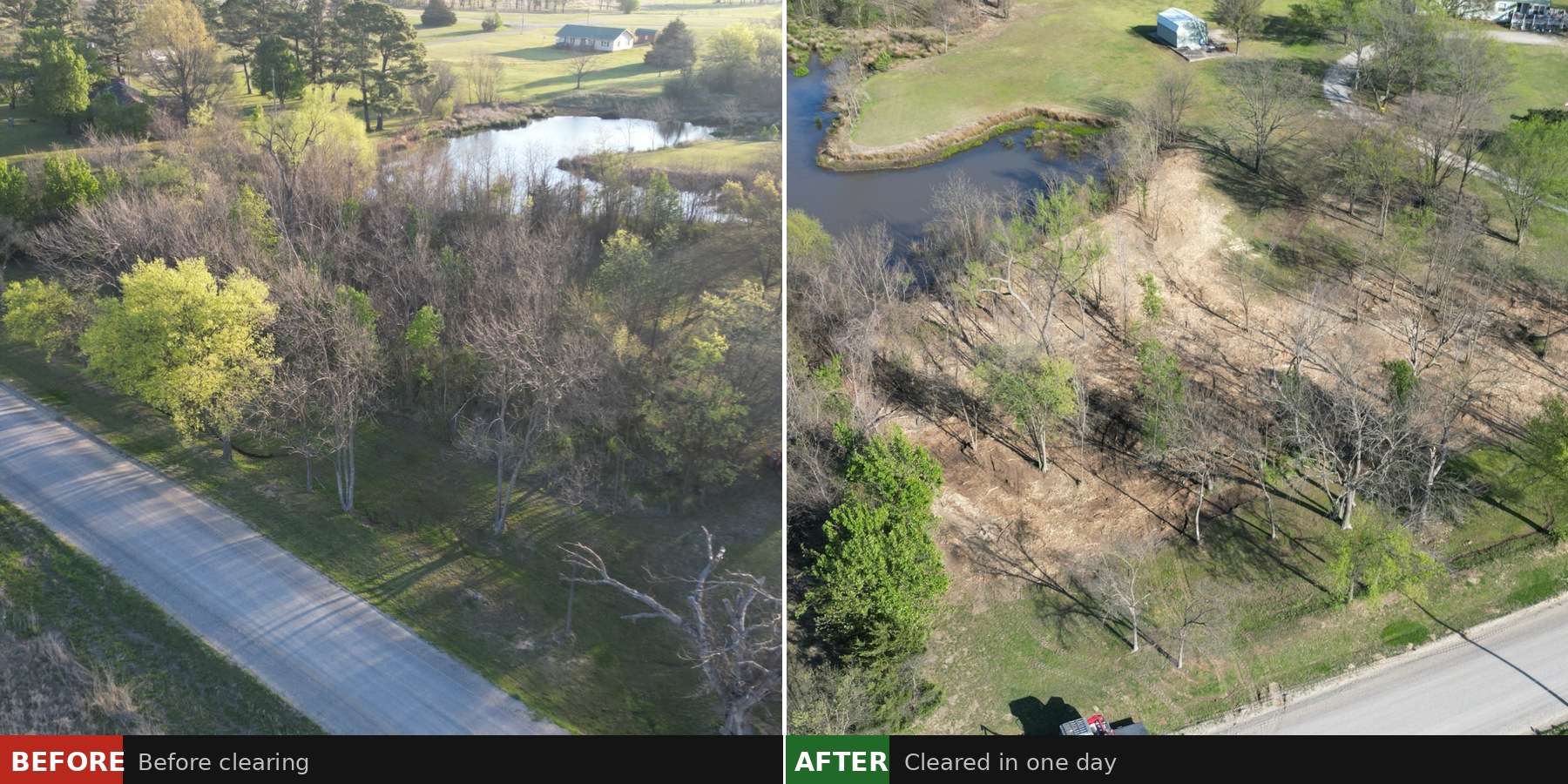
Brush is what takes a usable Oklahoma place and slowly closes it in. Plum thickets fill the fence rows. Sumac and locust creep out of the draws. Blackberry and greenbrier tie it all together until you cannot walk your own land. Oklahoma Mulch Works clears that growth by grinding it into mulch where it stands with a tracked Cat 275 and Mastodon forestry head.
No burn pile waiting on a calm day. No trailer loads to the dump. One machine works through the thicket and leaves a mulch layer you can walk on the same day.
The jobs we see most
Fence lines so you can rebuild or run new wire without fighting a hedge. Pasture edges so grass gets sun and cattle can use the acres you already own. Overgrown lots where the back half went wild years ago. Pond banks and draws where brush and scrub cedar moved in. Homesite pockets that need opening before a builder can even look at the place.
Most of this work is on 2-10 acre lived-on places around the west and north metro. It is rarely a full-tract wipe. We scope the part that matters, mark what stays, and clear the rest.
Brush clearing in the OKC metro
Inside the metro the job changes shape but not substance: overgrown back lots in Oklahoma City and Edmond, creek-line brush behind subdivisions, and acreage in Yukon, Mustang, and Piedmont where the previous owner let the back half go. Same machine, same flat quote, shortest drives we have.
Why mulching is the right tool for brush
A dozer pushes brush into piles and takes the topsoil with it. A skid steer grapple moves it but leaves you a mountain to burn or haul. Mulching turns the brush into ground cover in the same pass that cuts it. The soil stays put. The roots hold the ground. Grass comes back through the mulch instead of fighting bare dirt and washouts. See the side-by-side on our land clearing page.
What it costs
One flat total after we walk it. Brush density changes more from one fence row to the next than any per-acre chart can capture, so we do not guess over the phone. Walk it with us and you get a firm number for a defined scope. For a rough ballpark, use the instant pricing calculator first.
Nearby services
Heavy cedar stands are their own animal. See cedar removal. Whole-place clearing and build-site prep live under land clearing. If the job ends with a pad, a driveway, or dirt moved, we now scope that too under dirt work.
Common Questions
What counts as brush?
Plum thickets, sumac, locust, blackberry, greenbrier, scrub cedar, and the mixed regrowth that takes over fence rows and pasture edges. If you cannot walk through it, it is brush to us.
Will the brush come back?
Some species resprout and seed in the soil can germinate, so a mulched area needs light maintenance like mowing or spot treatment. The mulch layer slows regrowth compared to scraped dirt.
How is this different from brush hogging?
A brush hog cuts light growth a few inches above ground and leaves stems. Our forestry head grinds heavier brush and small trees to ground level and turns them into mulch. It handles growth a brush hog bounces off of.
Get the brush off your place
Call (405) 870-1381 or request a walk. Tell us the town, roughly how many acres, and what the brush is keeping you from doing. We will walk it and send one flat number.
Request a Walk →